Hong Kong builds strategic case for a gold hub

This article, the third of a four-part series, is co-authored by Lawrence Au and Margery Wong, chair and vice-chair, respectively, of the FinEx Club Research Centre asset-servicing committee, with the support of researcher Leo Chung. The Centre, which provides insights on key financial sector issues, is a think tank of the FinEx Club, a network of senior financial executives.
Hong Kong’s gold hub initiative is not just about building vaults or clearing trades. It is a deliberate recalibration of Asia’s financial architecture designed to secure the city’s long-term competitiveness while advancing China’s reserve diversification agenda.
But as global capital fragments and priorities for reserves evolve, the city faces a critical balancing act: delivering geopolitical value while maintaining the cross-border trust that institutional allocators demand.
The gold hub initiative addresses a structural vulnerability for Hong Kong which remains heavily reliant on traditional banking, equity markets, and Mainland initial public offerings, which are all areas that are under pressure from shifting capital flows and regional uncertainty.
By building a high-trust, high-volume commodity ecosystem, Hong Kong can diversify its revenue base and generate more stable recurring fee income from vaulting, assaying, trade finance, and custody.
Just as importantly, the gold initiative positions the city as a specialist platform for one of the world’s most actively accumulated hard assets.
According to figures from the Observatory of Economic Complexity, Hong Kong imported US$64.88 billion of gold in 2024 and exported $56.6 billion , representing 11.5% and 9.6%, respectively, of global flows.
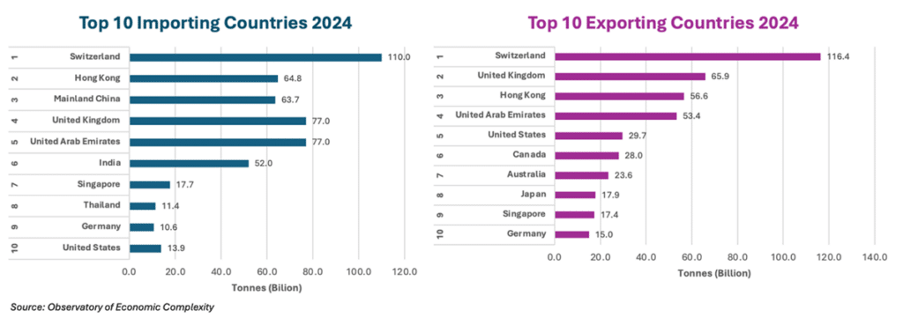
Hong Kong chief executive John Lee noted that the city was already among the world’s largest gold import and export markets by volume. “Hong Kong’s security and stability within the complex geopolitical environment makes it an attractive location for investors for gold storage, which in turn supports related activities such as gold trading, settlement, and delivery,” he said when introducing the gold hub initiative.
The stakes are substantial. A mature gold ecosystem would diversify Hong Kong’s financial sector’s exposure from traditional segments that have faced volatility from evolving market dynamics, while leveraging its existing role as a physical gold transit hub.
The strategic logic is equally clear for Beijing. China’s need to reduce structural dependence on US dollar clearing systems has grown amid repeated rounds of Western financial sanctions. Gold can strengthen financial resilience in periods of economic and geopolitical uncertainty because it is politically neutral, carries no default or credit risk, and is less vulnerable to freezing or seizure by foreign authorities.
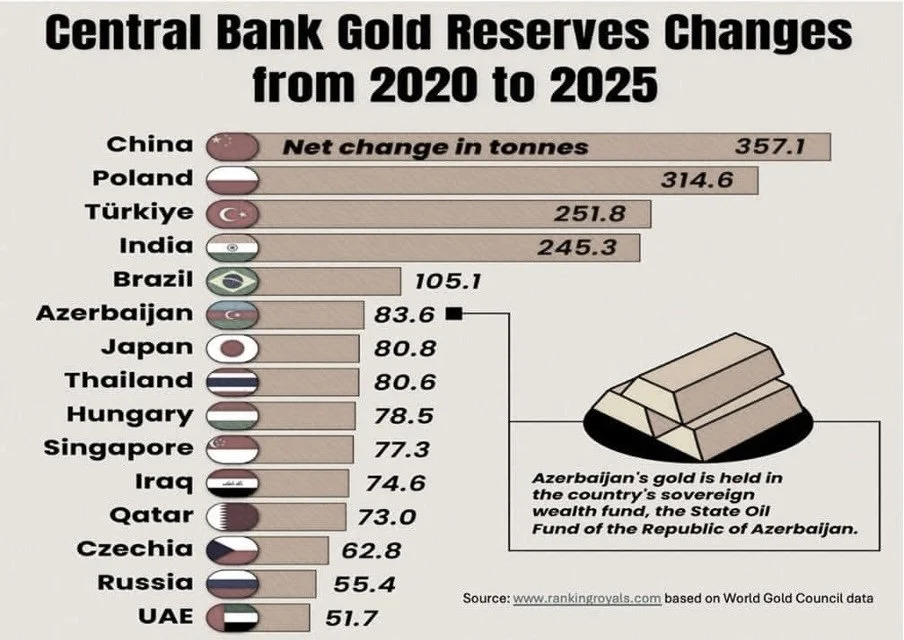
This aligns with broader reserves diversification trends. The People’s Bank of China (PBOC) has increased its gold reserves by 357.1 tonnes over the last five years. As of end-2025, the central bank held 2,306 tonnes of gold representing 8.5% of its total foreign reserves.
Poland, Turkey, and India also increased their gold reserves by more than 200 tonnes over the same period. A World Gold Council survey in June found that a record 45% of central banks planned to increase their holdings of the yellow metal over the next 12 months.
A Nikkei Asia report in February described Beijing’s vision to make Hong Kong a gold hub as a “bid for market dominance” intended to increase its influence over international pricing that has long been anchored in London and New York.
Geopolitics
Hong Kong’s gold initiative also supports internationalisation of the Chinese currency. Despite China’s economic scale, the renminbi accounts for just 3%–4% of global payments and 2%–3% of reserves holdings compared with more than 40% for the US dollar.
A gold clearing system based in Hong Kong that enables RMB settlements would provide a practical, market-driven use case for the currency’s cross-border liquidity without requiring full liberalisation of China’s capital account.
The gold hub also aligns with Beijing’s Belt and Road financial architecture. Many partner economies are significant gold consumers or producers. Gold-denominated RMB settlement could support trade invoicing and project financing across Belt and Road corridors, offering a locally accessible mechanism for cross-border payments that can hold up against sanctions.
Central banks and institutional investors across the Middle East, Southeast Asia, and Africa would have stronger incentives to hold the Chinese currency if RMB reserves could be deployed in a deep, reliable and sanctions-resilient gold market.
Hong Kong’s unique advantage is its ‘One Country, Two Systems’ framework. As a common law jurisdiction with open capital flows, transparent regulation and deep international market links, it offers a rare combination of access to the Mainland alongside global institutional trust. This positions Hong Kong as a neutral clearing centre where Eastern physical demand meets Western financial standards.
The city’s assay facilities already hold London Bullion Market Association (LBMA) Good Delivery accreditation, and the Hong Kong Gold Exchange (HKGX) is developing blockchain-enabled traceability to align with LBMA Responsible Gold guidance.
However, as Western concerns about China’s influence over Hong Kong increase, international players may face greater uncertainty.
International banks operating under US or European Union rules must navigate Office of Foreign Assets Control (OFAC) sanctions, export controls and heightened due diligence regimes. Since the Hong Kong hub is closely tied to RMB internationalisation and linked to the Shanghai Gold Exchange, Western institutions may face increased compliance requirements.
This may not prevent participation, but it can raise operational costs and exacerbate clearing latency during Asian hours, potentially slowing involvement of the liquidity providers needed in the early stages.
The governance structure of the Hong Kong Precious Metals Central Clearing Ltd is designed to mitigate this friction. There are 11 banks on its board including HSBC, JPMorgan Chase, UBS Group, Industrial & Commercial Bank of China, and Bank of China, signalling broad market support from both Western and Chinese financial institutions. This composition reflects an intention to operate the infrastructure as a bridge between jurisdictions rather than as a partisan platform.
Success factors
Whether Hong Kong reaches institutional scale or remains a well-funded niche venue will depend on three interlinked factors: liquidity, settlement interoperability, and transparency.
The first factor is the quality and commitment of initial market makers. Depth cannot develop organically without early liquidity providers willing to provide two-way prices and absorb inventory risk during Asian trading hours. Established markets such as the LBMA over-the-counter network clear approximately $1.1 trillion weekly, while New York’s Commodity Exchange or COMEX futures handle nearly 27 million ounces daily.
In Hong Kong, activity on the HKGX’s 99 Tael Gold product has improved, with average daily turnover reported to have more than doubled year-on-year through late 2024 to reach HK$2.9 billion(US$369.8 million). However, sustained liquidity requires visible balance sheet commitment from major participants such as sovereign wealth funds, Gulf allocators, or tier-one LBMA-accredited banks.
Hong Kong must also offer credible cost or efficiency advantages to make it attractive for companies to commit long-term capital and conduct trades in the city, including competitive stamp duty and tax treatment for gold financing, as well as optimised clearing margins.
The second factor is cross-border settlement interoperability. Genuine price discovery depends on seamless integration between the hub’s clearing system, the Shanghai Gold Exchange, and international custodians. While the technical foundation for RMB settlement already exists, a gold-specific cross-border scheme between Hong Kong and China supported by clear policy will need to be created, akin to the Stock and ETF Connect schemes.
Alignment among the Hong Kong Monetary Authority, the Securities and Futures Commission and the PBOC on cross-border position reporting, margin rules and capital flow monitoring will serve as one of the clearest signals of the hub’s long-term viability.
The third factor is operational transparency and independent verification. Global investors will only allocate capital to a new commodity venue if inventory is auditable and reporting is credible. The HKGX’s blockchain traceability efforts and LBMA alignment are positive steps; however, credibility will ultimately depend on visible third-party audits.
A practical, high-impact approach would be an annual public inventory audit by a recognised global assayer, supported by real-time reporting of cleared volumes. This would close the information gap that often discourages early participation and could be implemented within the existing framework.
While the strategic calculus is clear, Hong Kong’s gold hub can succeed only by building trust and sustained credibility.
Global competition has set a high bar. London and New York benefit from deep liquidity and centuries of established confidence. Hong Kong must demonstrate consistency to match that standard.
*This article was published by Asia Asset Management on August 28, 2026.